US Visit Visa Consultant: A Complete Guide for Pakistani Applicants
Planning a trip to the United States can be exciting. Maybe you want to see New York, visit family in California, explore Washington, D.C., or simply enjoy a holiday in a country you’ve always wanted to experience.
Then comes the visa process.
For many Pakistani applicants, the challenge isn’t the desire to travel. It’s understanding how to present a clear, honest, and well-organized application. Questions quickly come up: Which visa category applies? What documents should you prepare? How should you complete the application form? What happens at the interview? And what can you do if you’re worried about making a mistake?
Working with a professional US visit visa consultant can help you understand these steps and prepare your application in a more organized way.
A consultant can’t guarantee approval, and no legitimate professional should promise that. What professional assistance can do is help you understand the process, identify relevant documents, review your information, and prepare you to answer questions honestly and confidently.
This guide explains the US visitor visa process from Pakistan, including eligibility, documentation, the application process, interview preparation, common mistakes, and practical tips that can help you approach the process with greater confidence.

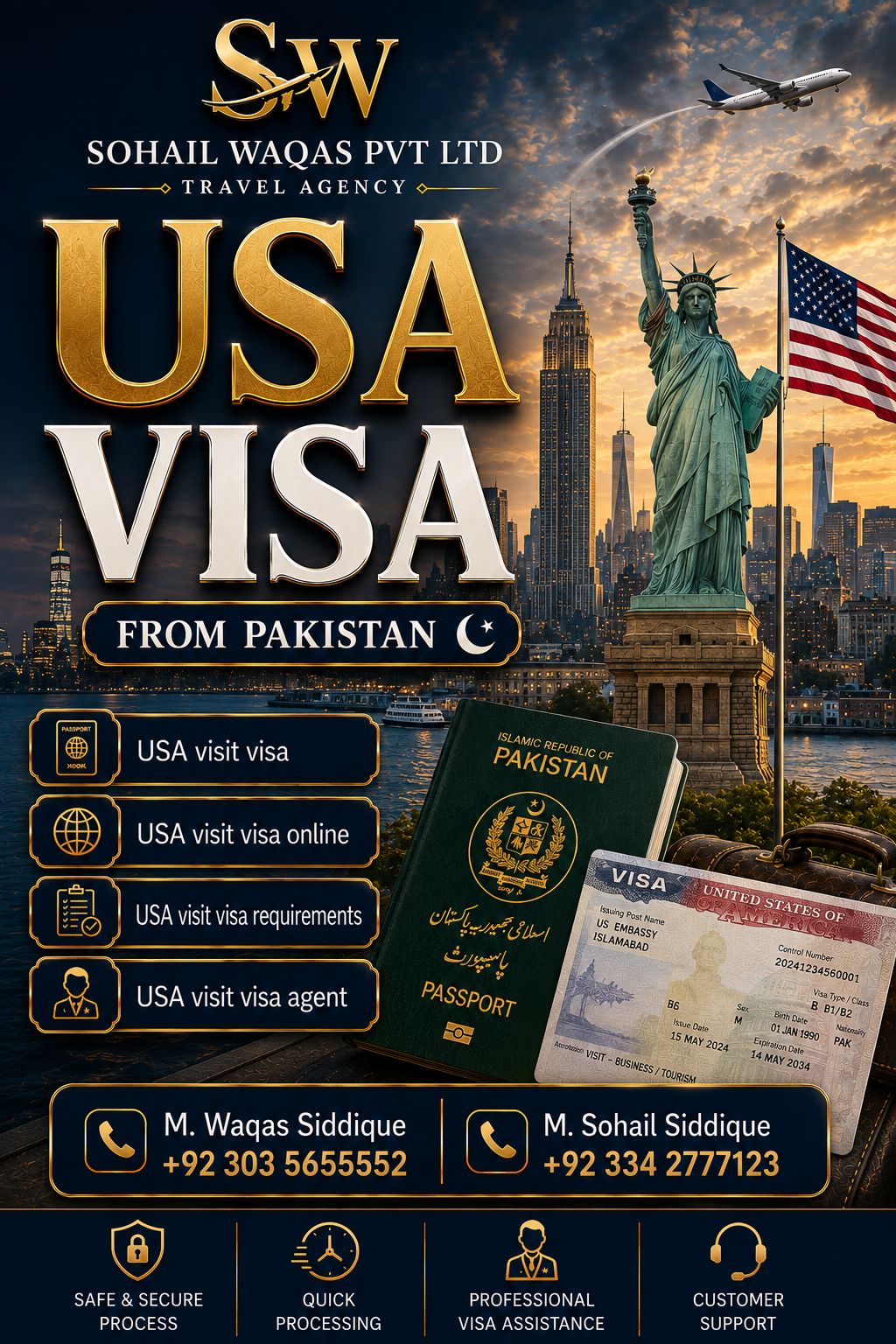
What Is a US Visit Visa?
A US visitor visa is a temporary nonimmigrant visa for eligible travelers who want to enter the United States for permitted short-term purposes.
For many tourists and people visiting relatives or friends, the relevant category is the B-2 visitor visa. Some travelers may fall under a combined B-1/B-2 category when their visit includes permitted business and tourism activities.
Your visa category should match the actual purpose of your trip.
If you’re planning a family holiday, don’t try to describe it as a business trip simply because you think another category sounds stronger. Your application should reflect your genuine intentions.
A straightforward application built around truthful information is a much better starting point than trying to create a story that doesn’t match your circumstances.
Why Do Applicants Seek Professional Visa Assistance?
The US visa process has several stages, and each stage requires attention to detail.
A US visit visa consultant can help applicants understand the process and prepare their information before submission. This can be particularly helpful for first-time applicants who aren’t familiar with the application system.
Professional guidance may help you:
-
Understand the appropriate visitor visa category
-
Organize your personal information
-
Prepare for the online application form
-
Identify relevant supporting documents
-
Review information for inconsistencies
-
Understand the biometric and appointment process where applicable
-
Prepare for common interview questions
-
Avoid avoidable application mistakes
-
Understand what information should be presented clearly
-
Organize your documents before attending the interview
Think of the consultant as a guide through a complicated road map. They don’t decide where the road ends, but they can help you understand the route and avoid unnecessary wrong turns.
Who Should Consider Using a US Visa Consultant?
You don’t necessarily need professional assistance simply because you’re applying for a visa. However, some situations can make guidance particularly useful.
You may benefit from assistance if:
-
You’re applying for the first time.
-
You’re unsure about the correct visa category.
-
You’re visiting family or friends in the United States.
-
You’re self-employed or own a business.
-
Your income comes from different legitimate sources.
-
You’re travelling with family members.
-
Your circumstances have recently changed.
-
You have previous international travel history you’d like to present clearly.
-
You’re unsure how to organize your supporting information.
-
You want your application reviewed before submission.
For a straightforward applicant, the process may feel manageable. For someone with a more complicated personal, employment, financial, or travel background, having another experienced person review the details can be useful.
What Does a US Visitor Visa Officer Look At?
Applicants sometimes make the mistake of thinking that one document determines the entire decision.
That’s rarely a helpful way to look at the process.
The application and interview provide an overall picture of your circumstances, your travel purpose, and your eligibility under the applicable visitor visa requirements.
An applicant should be ready to explain:
-
Why they want to visit the United States
-
How long they expect to stay
-
Where they plan to go
-
Who they may visit
-
How the trip will be supported
-
What they do in Pakistan
-
Their family or professional circumstances
-
Their previous travel history when relevant
-
Why they intend to return after the temporary visit
The exact questions can vary.
That’s why memorizing a scripted speech isn’t a good strategy. You should understand your own application well enough to explain it naturally.
The Importance of Your Travel Purpose
Your reason for travelling should be clear.
Tourism, visiting family, and certain other temporary visitor activities can fall under visitor visa rules, but the details matter.
Imagine someone says they’re travelling to the United States for tourism. During the interview, they’re unable to name even a general destination or explain what they hope to do there.
That may create unnecessary uncertainty.
You don’t need to memorize every street and attraction. You simply need to understand your own travel plan.
For example, a genuine tourism plan might involve:
-
Visiting a particular city
-
Seeing well-known attractions
-
Spending time with family or friends
-
Taking a short holiday
-
Exploring several destinations during a planned trip
Keep your explanation simple and truthful.
Financial Evidence and Your Circumstances
Financial information can be an important part of explaining how your trip will be supported.
Your circumstances may include salary, business income, savings, or other legitimate sources of funds. If another person is helping with your travel expenses, the application should reflect that honestly.
Relevant documents can vary, but applicants may have evidence such as:
-
Bank statements
-
Salary records
-
Employment letters
-
Business documentation
-
Tax-related records where relevant
-
Pension or other legitimate income evidence
-
Evidence relating to a sponsor or family member when applicable
Here’s what most people miss: having a large bank balance by itself doesn’t automatically make an application strong.
The broader financial picture matters.
If your stated income and financial activity don’t appear to make sense together, you may need to explain the situation.
Never create artificial transactions or submit altered financial documents. Genuine records are always the safer foundation.
Employment and Professional Commitments
Your work situation can help explain your circumstances in Pakistan.
For an employed applicant, relevant information may include:
-
Job title
-
Employer
-
Length of employment
-
Approved leave
-
Expected return to work
For a business owner, the picture may involve business registration, ongoing operations, responsibilities, and other relevant evidence.
For a student, educational commitments may be relevant.
The point isn’t to collect every document you can find. The point is to provide truthful information that helps explain your situation.
Family and Social Ties
Applicants often hear the phrase “strong ties” and assume it means they need to own property.
That’s too narrow.
Your overall circumstances can include employment, business responsibilities, education, family commitments, and other established connections to your home country.
Every applicant is different.
For example, a business owner with an active company may have very different reasons to return than a university student. An employed professional may have an approved leave period and an ongoing job. A parent may have important family responsibilities.
Your application should reflect your actual circumstances rather than trying to copy somebody else’s profile.
Documents Commonly Considered for a US Visitor Visa
There isn’t one universal document bundle that fits every applicant.
The appropriate documents depend on your personal circumstances and the purpose of your visit.
| Document or Information | Possible Purpose |
|---|---|
| Valid passport | Establishes identity and travel document information |
| Visa application information | Provides details about the proposed visit |
| Employment evidence | Explains professional circumstances |
| Financial records | Helps show how the trip may be supported |
| Business documents | Relevant to business owners |
| Educational records | May be relevant to students |
| Travel history | Can provide context about previous international travel |
| Family information | Helps explain personal circumstances |
| Invitation information | May be relevant when visiting someone in the US |
| Travel plan | Helps explain the purpose of the proposed trip |
Not every applicant needs every item.
A common mistake is to treat this table as a fixed checklist. Your documentation should be based on your actual situation and the current instructions applicable to your application.
Step-by-Step US Visit Visa Application Process
Understanding the overall process can make it easier to plan.
Step 1: Identify the Correct Visa Category
Start by determining why you’re travelling.
If you’re visiting the United States temporarily for tourism or another permitted visitor activity, a visitor visa may be appropriate. If your purpose is different, another immigration category may apply.
Don’t choose a category simply because someone tells you it’s easier.
Step 2: Review Your Personal Circumstances
Before filling out the application, gather the facts.
Review:
-
Your passport information
-
Employment
-
Education
-
Business activities
-
Family circumstances
-
Travel history
-
Proposed trip
-
Financial situation
-
Previous US visa history, if applicable
This is where professional review can be useful. A second pair of eyes may identify an inconsistency that you haven’t noticed.
Step 3: Complete the Online Application
The applicable US nonimmigrant visa application form requires detailed personal and travel information.
Read every question carefully.
Don’t rush through the form simply because you want to finish it quickly. An incorrect answer can create problems later, especially if the information conflicts with what you say during the interview.
Step 4: Pay the Applicable Government Fee
The application involves applicable government charges. Because official fees and procedures can change, applicants should verify the current information before submitting their application.
This article deliberately doesn’t provide pricing or cost estimates.
Step 5: Schedule the Required Appointment
Depending on your circumstances and the current process, you’ll need to follow the appointment instructions for the US visa application process.
Keep your confirmation details and required documents organized.
Step 6: Prepare for the Interview
This is one of the most important stages for many applicants.
The interview is generally brief, so you should be able to explain your situation clearly without giving a long speech.
Practice understanding your application rather than memorizing answers.
Step 7: Attend the Interview
Answer questions truthfully and directly.
If the officer asks why you want to visit, answer the question. If they ask about your job, explain your job. Don’t turn a simple question into a five-minute explanation.
Confidence doesn’t mean talking constantly.
Sometimes the strongest answer is a short, clear answer.
Step 8: Follow the Outcome Instructions
After the interview, follow the instructions provided regarding your application and passport.
Processing outcomes and timelines can vary, so don’t assume that every application will follow exactly the same schedule.
How to Prepare for the US Visa Interview
The interview can feel intimidating, especially if it’s your first time.
But you don’t need to treat it like a school exam.
Start by knowing your own application.
Be prepared to discuss:
Your Purpose
Know why you’re travelling and what you intend to do.
Your Trip
Understand your approximate travel plan and intended length of stay.
Your Job or Business
Be able to explain what you do in Pakistan in simple terms.
Your Family Situation
Know the relevant details about your immediate circumstances.
Your Finances
Understand how the trip will be supported.
Your Travel History
If you’ve travelled internationally before, be familiar with your previous trips and visa history.
A consultant can conduct practice questions with you so that you become more comfortable answering naturally.
Common US Visa Interview Questions
Interview questions can vary, but applicants may be asked things such as:
-
Why do you want to visit the United States?
-
Where do you plan to go?
-
How long will you stay?
-
What do you do for work?
-
Who will pay for your trip?
-
Do you have relatives in the United States?
-
Have you travelled abroad before?
-
Why are you travelling at this particular time?
-
What will you do after returning to Pakistan?
Don’t memorize answers word for word.
Suppose your actual job is running a family business. If you memorize a generic answer like “I am a businessman,” you may struggle when asked what the business does.
Instead, understand your own story.
Common Mistakes Applicants Should Avoid
Mistake 1: Memorizing Fake Answers
Interview officers can ask follow-up questions.
If you’ve memorized someone else’s script, you may quickly get stuck.
Mistake 2: Giving Too Much Information
Being honest doesn’t mean providing an unrelated life story.
Answer the question you’re asked.
Mistake 3: Contradicting Your Application
Your interview answers should be consistent with the information you submitted.
Review your application before attending the interview.
Mistake 4: Providing False Documents
Never use fake, altered, or misleading documents.
The consequences can be serious and can affect your immigration history.
Mistake 5: Claiming a Relationship That Doesn’t Exist
If you’re visiting someone, describe your relationship accurately.
Don’t turn an acquaintance into a close relative simply because you believe it will make the application stronger.
Mistake 6: Treating an Invitation as a Guarantee
Having a relative or friend in the United States doesn’t automatically mean a visitor visa will be approved.
The applicant’s own circumstances and purpose remain important.
Mistake 7: Assuming Property Ownership Is Mandatory
Property can be part of someone’s circumstances, but applicants shouldn’t assume that everyone needs to own property to qualify.
Your complete situation matters.
Mistake 8: Relying Entirely on an Agent
A consultant can help prepare you, but you should understand the information being submitted in your name.
Before signing or submitting anything, review it.
Consultant vs. Applying Without a Consultant
Both approaches can have advantages and disadvantages.
| Approach | Potential Advantages | Potential Challenges |
|---|---|---|
| Apply independently | Full control over the application | You must research and manage every step yourself |
| Use a consultant | Structured guidance and document review | You need to choose a trustworthy professional |
| Consultant + self-review | Professional assistance with personal oversight | Requires active participation from the applicant |
There isn’t one option that is right for everyone.
If your situation is simple and you’re comfortable handling the process, you may prefer to manage it yourself.
If you’re uncertain about the process or want an experienced person to review your preparation, professional assistance may be helpful.
How to Choose a Reliable US Visit Visa Consultant
Choosing the right consultant matters.
Don’t base your decision only on promises or advertisements.
Look for someone who:
-
Explains the process clearly
-
Reviews your actual circumstances
-
Encourages truthful documentation
-
Doesn’t promise guaranteed approval
-
Doesn’t encourage fake documents
-
Explains potential weaknesses honestly
-
Reviews forms carefully
-
Helps you prepare for the interview
-
Communicates clearly
-
Allows you to understand what is being submitted
In my experience, transparency is one of the biggest signs of professional visa assistance.
If someone immediately says, “Your visa is guaranteed,” without even asking about your circumstances, that’s a reason to be cautious.
What a Good Consultation Should Cover
A useful consultation should go beyond simply handing you a document checklist.
Ideally, it should cover:
-
Your reason for travelling.
-
Your intended length of stay.
-
Your employment or business situation.
-
Your financial circumstances.
-
Your family situation.
-
Your previous travel and visa history.
-
Your application information.
-
Potential areas that need clarification.
-
Interview preparation.
-
Final document review.
The process should be based on your actual circumstances.
Tips for First-Time Applicants
If this is your first US visitor visa application, don’t let the process overwhelm you.
Start early and work methodically.
Write down your basic travel purpose in one or two sentences. Review your employment or business details. Check your financial records. Make sure you know your own travel history.
Then review the application information carefully.
You don’t need to become an immigration expert overnight. You just need to understand what you’re submitting and why.
What If Your US Visa Application Is Refused?
A refusal can be disappointing, but it doesn’t mean you should immediately submit another application without understanding what happened.
Start by reviewing the information provided with the refusal.
Ask yourself:
-
Has anything genuinely changed?
-
Was your previous application accurate?
-
Were there inconsistencies?
-
Did your circumstances change?
-
Can you now explain your purpose more clearly?
-
Have your employment, family, financial, or travel circumstances changed?
Simply changing a few sentences isn’t necessarily enough.
A future application should always be truthful and based on your current circumstances.
Professional guidance may be useful if you’re unsure how to understand or address the situation.
Why Preparation Matters More Than Paperwork Volume
Imagine two applicants.
The first carries a huge folder filled with every document they could find. The second has a smaller, organized set of relevant evidence and understands every detail in the application.
The second applicant may be much better prepared.
More paperwork doesn’t automatically mean a stronger case.
The real goal is clarity.
Your information should be genuine, relevant, consistent, and easy to understand.
A Practical Pre-Interview Checklist
Before your interview, review the following:
-
Your passport details
-
Your application confirmation
-
Appointment information
-
Your intended travel purpose
-
Your planned destinations
-
Your expected length of stay
-
Your employment or business details
-
Your financial circumstances
-
Your family situation
-
Your previous travel history
-
Your previous visa history, if applicable
-
Any supporting documents relevant to your circumstances
Most importantly, read your own application.
You’d be surprised how often applicants forget what they entered weeks earlier.
When Should You Contact a US Visa Consultant?
The best time is usually before you’ve submitted your application.
Early guidance gives you time to identify missing information, correct mistakes, collect relevant evidence, and prepare for the interview.
Waiting until the day before an appointment can make the process unnecessarily stressful.
If you already have an application in progress, professional review may still help you understand the next steps and prepare appropriately.
Final Thoughts
A US visitor visa application should be approached with preparation, honesty, and attention to detail.
You don’t need a complicated story. You need a genuine reason for travelling, accurate information, appropriate supporting evidence, and a clear understanding of your own circumstances.
A professional US visit visa consultant can help you navigate the process, review your application information, organize relevant documents, and prepare for the interview. The right consultant won’t promise something they can’t control. Instead, they’ll help you understand what you can control: the accuracy and quality of your preparation.
If you’re planning a visit to the United States from Pakistan, don’t leave your preparation until the last moment.
Review your circumstances, understand the applicable requirements, organize your information, and prepare for your interview with confidence.
For professional assistance with your US visit visa preparation, contact the visa consultants listed below and discuss your individual circumstances before proceeding.
4. FAQ Section
1. What does a US visit visa consultant do for Pakistani applicants?
A US visit visa consultant can guide applicants through the application process, help organize relevant documents, review application information, and provide interview preparation. A consultant cannot guarantee the final visa decision.
2. What documents are needed for a US visit visa from Pakistan?
The required information and supporting documents depend on the applicant’s circumstances and travel purpose. Common evidence may include passport information, financial records, employment or business documents, and information supporting the proposed visit.
3. How can I prepare for a US visit visa interview?
Understand your application, travel purpose, employment or business situation, financial circumstances, and travel history. Answer questions truthfully, directly, and naturally rather than memorizing scripted responses.
4. Can a US visit visa consultant guarantee visa approval?
No. No legitimate consultant can guarantee approval because the decision is made by the relevant US authorities. Be cautious of anyone promising guaranteed approval.
5. Is a bank statement required for a US visitor visa application?
Financial information may help explain how your proposed trip will be supported and provide context about your circumstances. The appropriate evidence depends on your individual situation.
6. When should I contact a US visit visa consultant?
Ideally, seek guidance before completing and submitting your application. Starting early gives you more time to review your information, organize relevant evidence, and prepare for the interview.
5. Contact Details
M. Waqas Siddique: +92 303 5655552
M. Sohail Siddique: +92 334 2777123
Related Reading: Turkey Visit Visa from Pakistan: Complete Guide
