
Indonesia Investor Visa From Pakistan: A Complete Guide for Pakistani Investors
Indonesia is becoming an increasingly interesting destination for entrepreneurs, business owners, and international investors who want to build a presence in Southeast Asia. With a large domestic market, growing commercial sectors, and opportunities across different industries, the country can be an attractive place to explore long-term business plans.
For a Pakistani entrepreneur, however, investing in another country involves more than identifying a promising business opportunity. You also need to understand the immigration rules that determine how you can enter, stay, and participate in your investment.
If your plan is simply to visit Indonesia for meetings or explore an opportunity, a short-term business-related immigration option may be enough. But if you intend to establish a qualifying investment and maintain a longer-term presence in the country, an investor residence route may be more relevant.
This guide explains the Indonesia investor visa from Pakistan process in practical language. You’ll learn what an investor visa is, who may qualify, what documents may be required, how the application generally works, what investors can and can’t assume about their rights, common mistakes, and how to prepare before making important decisions.
The biggest lesson is simple: your investment plan and immigration status should fit together from the beginning.

What Is an Indonesia Investor Visa?
An investor visa or investor residence route is designed for eligible foreign investors who meet Indonesia’s applicable investment and immigration requirements.
It is different from a standard tourist visit. It’s also different from a short business trip where you’re simply attending meetings or exploring potential opportunities.
An investor-focused immigration status can be relevant when a foreign national has a qualifying investment and wants to maintain a longer-term presence connected to that investment.
Depending on the applicable category and current regulations, an investor may be involved in activities such as:
-
Participating in a qualifying Indonesian business
-
Maintaining an eligible investment
-
Managing or overseeing an investment
-
Developing a commercial venture
-
Building relationships with local business partners
-
Establishing a long-term business presence
-
Residing in Indonesia while meeting the required investment conditions
The exact rights and conditions depend on the immigration category granted.
That’s why you shouldn’t choose an immigration route based only on the word “investor.” The details matter.
Why Pakistani Investors Are Interested in Indonesia
Indonesia offers a combination that many international entrepreneurs find attractive: a large population, diverse industries, developing infrastructure, and access to regional commercial networks.
For Pakistani investors, the country may offer opportunities in areas such as:
-
Trading
-
Manufacturing
-
Technology
-
Digital services
-
Tourism
-
Hospitality
-
Logistics
-
Consumer products
-
Professional services
-
Other permitted investment sectors
Of course, an attractive market doesn’t mean every business will succeed.
A good investment decision requires research into demand, competition, regulation, licensing, local partners, operating conditions, and long-term business prospects.
Think of the visa as one piece of the puzzle. The business itself is the bigger picture.
Who May Be Eligible?
Eligibility depends on the specific Indonesian investor immigration category and the requirements in force when you apply.
Potential applicants may include:
-
Pakistani entrepreneurs
-
Business owners
-
Company founders
-
Overseas investors
-
Shareholders
-
Corporate executives
-
Directors of qualifying companies
-
International business groups
-
Investors establishing a qualifying presence in Indonesia
But there’s an important point here.
Simply saying, “I want to invest in Indonesia,” doesn’t automatically make someone an eligible investor.
Immigration authorities may look at the actual investment structure, corporate arrangements, ownership, documentation, and other conditions.
Your nationality is also relevant because you’re applying as a Pakistani passport holder.
Indonesia Investor Visa From Pakistan: What Should You Consider First?
Before you begin the application process, take a step back and look at your complete plan.
Ask yourself:
-
Why do I want to invest in Indonesia?
-
What type of business am I considering?
-
Have I already invested, or am I still exploring?
-
What will my role in the business be?
-
How long do I want to stay in Indonesia?
-
Will my family accompany me?
-
Do I need to manage the business personally?
-
What corporate structure will hold the investment?
These questions can reveal whether you’re actually looking for an investor residence route or whether a short-term business option would be more suitable at the beginning.
Business Visa vs Investor Residence
This is one of the most common areas of confusion.
A business traveler might enter Indonesia to explore a potential investment.
An investor may already have a qualifying investment and want to establish a longer-term presence.
Example: Business Traveler
Imagine a Pakistani businessman who has never invested in Indonesia.
He receives an invitation from an Indonesian company and travels to Jakarta to:
-
Meet the owners
-
Visit the business
-
Discuss a potential partnership
-
Study the market
-
Review possible investment opportunities
His immediate purpose is exploration.
Example: Investor
Now imagine that after completing the necessary arrangements, the same entrepreneur has a qualifying investment in Indonesia and wants to spend substantial time there overseeing the investment.
His circumstances have changed.
An investor-focused residence route may now be relevant, assuming he satisfies the applicable requirements.
The key difference is not simply how much money someone has. It’s the nature of the investment, purpose of residence, business structure, and applicable immigration rules.
Tourist Visa vs Business Visa vs Investor Route
Understanding the basic differences can prevent a costly mistake in planning.
| Feature | Tourist Travel | Business Travel | Investor Residence |
|---|---|---|---|
| Tourism | Main purpose | May be limited by conditions | Depends on status |
| Business meetings | Not the primary purpose | May be permitted | May be possible |
| Market exploration | Not the primary purpose | May be suitable | May be relevant |
| Investment discussions | Not the primary purpose | May be permitted | Related to investment |
| Qualifying investment | Not required | Not necessarily required | Central to eligibility |
| Long-term residence | Generally not intended | Generally not intended | Intended for eligible investors |
| Employment | Restricted | Not automatically allowed | Depends on status and role |
| Family options | Category-dependent | Category-dependent | May be available under applicable rules |
This table is a general guide. The actual rights depend on the immigration category you receive.
Investment Requirements
One of the most important parts of an investor application is the investment itself.
Investor immigration categories can have specific requirements relating to the amount, structure, ownership, or nature of the investment.
These requirements may change over time.
That’s why you shouldn’t make an investment decision based on a figure you found in an old article or social media post.
Instead, verify the current requirements applicable to your intended category.
There’s another useful rule of thumb:
Don’t make a poor business investment just because you believe it will help with immigration.
Ask yourself whether the investment makes commercial sense independently of the visa.
If the business has a genuine market, realistic business model, suitable management, and long-term potential, you’re starting from a much stronger position.
What Documents May Be Required?
The exact document list depends on the specific immigration category and your personal circumstances.
However, investors should generally be prepared to provide documents that establish identity, investment, company structure, and the purpose of residence.
Potential documents can include:
-
Valid Pakistani passport
-
Recent photograph where required
-
Indonesian company documents
-
Investment documentation
-
Shareholding records
-
Corporate registration documents
-
Evidence of investment
-
Sponsor information where applicable
-
Business information
-
Indonesian address
-
Other supporting documents requested by immigration authorities
Don’t assume that every applicant needs exactly the same documents.
A person investing through one corporate structure may have different documentation from someone using another structure.
Passport Requirements
Your passport is the foundation of the application.
Before starting, check:
-
Full legal name
-
Passport number
-
Date of birth
-
Nationality
-
Expiry date
-
Passport condition
-
Required blank pages, where applicable
The information in your application should match your passport.
If your passport says “Muhammad Waqas Siddique,” don’t casually enter a shortened version unless the application instructions specifically require a different format.
Small discrepancies can lead to unnecessary questions.
Company and Investment Documents
Your corporate documentation helps demonstrate what you’re investing in and how that investment is structured.
Depending on your circumstances, you may need records relating to:
-
Company registration
-
Ownership
-
Shareholding
-
Investment
-
Business activities
-
Corporate management
-
Licensing
-
Indonesian business address
-
Other relevant corporate matters
Keep these records organized.
If your company has several shareholders, make sure the ownership information is consistent across the documents you provide.
If the company structure changes later, update the relevant records as required.
How to Apply: Step-by-Step Guide
The exact application process can vary, but the following framework can help you prepare.
Step 1: Define Your Investment Objective
Start with the business.
What are you trying to build?
Are you interested in:
-
Manufacturing?
-
Trading?
-
Technology?
-
Hospitality?
-
Logistics?
-
Tourism?
-
Services?
Your answer will influence the business structure and regulatory research you need.
Step 2: Research the Sector
Before investing, study the Indonesian market.
Look at:
-
Demand
-
Competition
-
Foreign investment rules
-
Licensing
-
Ownership restrictions
-
Business location
-
Supply chains
-
Workforce requirements
-
Local regulations
A promising business idea still needs proper due diligence.
Step 3: Determine the Business Structure
Work out how the investment will be held and operated.
The corporate structure can matter for both business and immigration purposes.
Step 4: Review Investor Eligibility
Once your investment structure is clear, determine whether it fits the relevant investor immigration category.
Don’t wait until after making major commitments to ask this question.
Step 5: Organize Your Documents
Create a digital folder containing your personal and business records.
Use clear filenames.
For example:
-
Passport.pdf
-
Company-Registration.pdf
-
Investment-Documents.pdf
-
Shareholding-Records.pdf
-
Business-Profile.pdf
This simple habit can make the process much easier.
Step 6: Complete the Application
Enter your information carefully.
Check every detail before submission.
Pay special attention to:
-
Name spelling
-
Passport number
-
Date of birth
-
Nationality
-
Company details
-
Investment information
-
Indonesian address
-
Travel information
Step 7: Submit Supporting Evidence
Provide the documents required for your particular immigration category.
Make sure scans are clear and complete.
Step 8: Monitor the Application
After submission, watch for updates or requests for additional documents.
If immigration authorities ask for clarification, respond with accurate information.
Step 9: Review the Approval
Once approved, don’t simply save the document and book your flight.
Read it.
Check:
-
Immigration category
-
Name
-
Passport number
-
Validity
-
Permitted stay
-
Entry conditions
-
Restrictions
-
Any other conditions
Step 10: Prepare for Arrival
Keep your passport and relevant immigration documents easily accessible.
You should also know the basic details of your Indonesian business.
If you’re asked about your investment, you should be able to explain it clearly.
What Makes a Strong Investor Application?
A strong application isn’t necessarily the one with the most paperwork.
It’s the one where the information makes sense.
Imagine an investor application containing:
-
A Pakistani passport
-
A clear company structure
-
Consistent ownership records
-
Evidence of investment
-
A logical business purpose
-
Accurate personal information
-
Supporting corporate documentation
Everything connects.
Now imagine another application where the applicant’s name is different across documents, company ownership isn’t clear, investment information conflicts, and the purpose of residence is vague.
More paperwork won’t necessarily solve the second problem.
Clarity matters.
How Long Can You Stay?
The permitted period depends on the specific investor immigration category and the approval granted.
It’s important to distinguish between:
-
Visa validity
-
Permitted stay
-
Number of entries
-
Residence validity
-
Extension conditions
These aren’t always the same thing.
For example, having a visa valid for a certain period doesn’t necessarily mean you can remain in Indonesia continuously for that entire period without considering the permitted stay conditions.
Always read the approval carefully.
Can Your Family Join You?
Depending on the investor residence category, eligible family members may have options to accompany the principal applicant.
Potential dependents can include:
-
Spouse
-
Children
-
Other qualifying family members
However, family members generally have their own immigration requirements.
Don’t assume that your approval automatically gives every family member the same status.
If you’re planning to relocate with your family, include that issue in your planning from the beginning.
Can Investors Work in Indonesia?
This is another area where applicants need to be careful.
Being an investor doesn’t necessarily mean you’re automatically authorized to perform every type of work in Indonesia.
Your permitted activities depend on your specific immigration status, your role in the company, and other applicable regulations.
For example, overseeing your investment may be different from taking a separate job with another Indonesian company.
Similarly, owning a business is different from personally performing regulated professional activities.
If your intended role involves employment or specialized work, check whether additional authorization applies.
Can You First Visit Indonesia to Explore Investment?
Potentially, an entrepreneur may begin with a short business trip if the purpose and visa category allow it.
This can be useful for:
-
Meeting local partners
-
Visiting business premises
-
Studying market conditions
-
Discussing company formation
-
Exploring suppliers
-
Negotiating potential investment
-
Understanding the local environment
For example, a Pakistani entrepreneur may travel to Jakarta for one week to meet a potential partner.
He hasn’t invested yet.
After returning to Pakistan, he decides to move forward with the project.
Once the investment structure is established, he may then consider whether an investor residence route is appropriate.
The two stages should not be confused.
Benefits of an Investor Residence Route
1. Longer-Term Business Presence
An eligible investor may have a more suitable immigration framework for maintaining a longer presence in Indonesia.
2. Greater Business Involvement
Depending on the conditions of the status, you may be able to remain closer to your investment.
3. Better Planning
Longer-term residence can make it easier to organize your business and personal life.
4. Potential Family Options
Eligible family members may have accompanying pathways under applicable rules.
5. Local Market Understanding
Living in the country can provide a deeper understanding of customers, suppliers, competitors, and business culture.
6. Stronger Business Relationships
Face-to-face relationships often develop differently from remote communication.
For many entrepreneurs, that can be valuable.
Potential Challenges
An investor route also comes with responsibilities.
You may need to deal with:
-
Corporate compliance
-
Immigration conditions
-
Investment requirements
-
Business licensing
-
Tax matters
-
Reporting requirements
-
Changes in ownership
-
Regulatory updates
-
Ongoing documentation
The visa shouldn’t be treated as a one-time form.
Long-term residence can involve continuing responsibilities.
Common Mistakes to Avoid
Mistake 1: Confusing Investment Exploration With Investment Eligibility
Meeting a business owner and discussing investment doesn’t automatically make you an investor under immigration rules.
Mistake 2: Investing Before Understanding the Structure
Don’t rush into a corporate arrangement before understanding whether it fits your commercial and immigration plans.
Mistake 3: Using Outdated Requirements
Immigration rules can change.
Always verify current requirements before acting.
Mistake 4: Providing Inconsistent Information
Your passport, corporate records, investment documents, and application should be consistent.
Mistake 5: Assuming the Investor Route Allows Everything
Every immigration category has conditions.
Mistake 6: Ignoring Family Planning
If you’re relocating with your spouse or children, investigate their immigration arrangements early.
Mistake 7: Leaving Preparation Until the Last Minute
Investor applications can involve more documentation than ordinary short-term travel.
Give yourself enough time.
Mistake 8: Choosing an Investment Solely for Immigration
A visa should support a sensible business strategy, not replace one.
Practical Tips for Pakistani Applicants
If you’re applying from Pakistan, organization is your friend.
Create a checklist before you start.
Keep Your Documents Consistent
Use the same spelling and details everywhere.
Keep Digital Backups
Store important documents securely.
Use Clear Scans
Blurry documents can create unnecessary problems.
Understand Your Business
You should be able to explain your investment in a few sentences.
Prepare for Questions
Know:
-
Your company name
-
Your business activity
-
Your ownership
-
Your role
-
Your Indonesian business address
-
Your reason for residing in Indonesia
Plan Ahead
Don’t treat the visa as the first step.
The real process begins with business planning.
A Real-World Example
Let’s consider a Pakistani entrepreneur who owns a trading company.
He has been studying Southeast Asian markets and identifies an Indonesian partner.
His first trip is exploratory.
He travels to Indonesia, meets the partner, visits the proposed operating location, studies suppliers, and discusses the possibility of establishing a business.
At this stage, he hasn’t yet completed his investment.
After returning to Pakistan, he conducts further due diligence and decides to move forward.
He then establishes the required business structure, completes the necessary investment arrangements, and organizes his corporate documentation.
Now his goal changes.
He wants to spend more time in Indonesia and actively oversee the investment.
This is when he should assess the investor residence route that applies to his specific circumstances.
Notice the sequence:
Explore → Research → Invest → Structure → Apply → Maintain compliance
That approach is much more logical than starting with a visa and trying to build a business around it.
What If Your Investment Changes?
Business plans can evolve.
You may:
-
Increase your investment
-
Reduce your ownership
-
Add a shareholder
-
Change your company role
-
Restructure the company
-
Change business activities
-
Sell the investment
-
Close the business
Major changes may affect your immigration status.
If your residence permission depends on specific investment conditions, don’t assume that a major change has no immigration consequences.
Review the applicable requirements before making significant changes.
What Should You Do Before Traveling?
Before leaving Pakistan, make sure you understand your documents and itinerary.
Keep accessible:
-
Passport
-
Immigration approval
-
Investment documentation
-
Indonesian company information
-
Business address
-
Sponsor details where relevant
-
Accommodation information
-
Relevant supporting records
You should also have a basic understanding of your business plans.
If an immigration officer asks why you’re entering Indonesia, answer honestly.
There’s no need for a complicated speech.
A simple explanation is usually better.
For example:
“I am entering Indonesia to manage my qualifying investment and meet with my business partners.”
The exact answer should always reflect your real circumstances.
Investor Residence vs Permanent Residence
These concepts shouldn’t be treated as identical.
An investor residence status may provide a specific period of lawful residence under certain conditions.
Permanent residence, where available, is a separate immigration concept with its own eligibility requirements.
Receiving an investor residence permit doesn’t necessarily mean you’ve automatically received permanent residence.
If your long-term goal is to live in Indonesia indefinitely, you should research the separate rules that may apply to long-term or permanent residence.
Tax and Business Compliance
Immigration is only one side of an international investment.
You should also consider:
-
Corporate tax
-
Personal tax
-
Reporting
-
Business licensing
-
Accounting
-
Employment rules
-
Banking
-
Corporate governance
-
Local regulations
Your immigration status doesn’t automatically determine your tax obligations.
Similarly, having an investment visa doesn’t replace the need to follow Indonesian business laws.
This is one reason international investors often work with professionals who understand both immigration and corporate matters.
Pros and Cons
Advantages
-
Can support a longer-term presence for eligible investors
-
May make business management more practical
-
Can support closer relationships with local partners
-
May offer family-related immigration options
-
Provides a structured route for qualifying investors
-
Allows an investor to plan around a more stable residence arrangement
Potential Disadvantages
-
Eligibility can involve significant requirements
-
Investment structure matters
-
Corporate compliance continues after approval
-
Immigration rules can change
-
Not designed for every business traveler
-
Investment and immigration obligations can continue over time
The right choice depends on your personal situation and business objectives.
Final Application Checklist
Before submitting your application, review the following:
-
Pakistani passport is valid
-
Personal details match the passport
-
Appropriate immigration category identified
-
Investment structure understood
-
Indonesian company documents prepared
-
Investment evidence organized
-
Ownership information is consistent
-
Sponsor information prepared if applicable
-
Indonesian address available where required
-
Supporting documents are readable
-
Application information has been reviewed
-
Family requirements considered
-
Permitted activities understood
-
Permitted stay checked
-
Current requirements verified
Final Thoughts
The Indonesia investor visa from Pakistan can be an important option for eligible Pakistani entrepreneurs who want to establish a genuine investment presence and spend more time in Indonesia.
But successful planning starts before the visa application.
First, understand the business. Research the market, investigate foreign investment rules, choose an appropriate structure, and make sure your investment has genuine commercial value.
Then look at immigration.
Your passport, company records, investment evidence, ownership information, and stated purpose should all support the same story.
Don’t confuse a short business visit with long-term investor residence. Don’t assume that an investor status automatically provides unrestricted employment rights. And don’t rely on outdated information when making important investment decisions.
A well-planned application is built around accurate information and a genuine business purpose.
If you’re a Pakistani entrepreneur considering Indonesia, prepare early and think about the complete picture: investment, immigration, business compliance, family planning, and long-term residence goals.
If you’re ready to explore your Indonesia investment and residence options, contact our team for assistance with document preparation, application guidance, and the next steps for your case.
FAQ Section
1. How can I apply for an Indonesia investor visa from Pakistan?
Start by identifying the appropriate investor immigration category for your circumstances. Then prepare your passport, investment evidence, Indonesian company documents, ownership records, and other required supporting documents before completing the applicable application process.
2. What are the requirements for an Indonesia investor visa from Pakistan?
Requirements depend on the specific investor category. They may include a valid Pakistani passport, qualifying investment evidence, Indonesian company documentation, ownership information, sponsor details where applicable, and additional immigration documents.
3. How much investment is needed for an Indonesian investor visa?
The applicable investor category may have specific investment thresholds and conditions. These requirements can change, so you should verify the current rules applicable to your intended immigration category before making an investment decision.
4. Can Pakistani investors bring their families to Indonesia?
Depending on the investor residence category, eligible family members may have options to accompany the principal investor. Spouses and children may need separate applications and supporting documents.
5. Can I work in Indonesia after receiving investor residence status?
Your permitted activities depend on your specific immigration status and business role. Investor residence doesn’t automatically mean you can perform every type of employment or professional activity without additional authorization.
6. Can I visit Indonesia before applying as an investor?
Yes, an entrepreneur may first travel for permitted business activities such as meetings, market research, or investment discussions under an appropriate immigration category. Once a qualifying investment is established, a different residence option may become relevant.
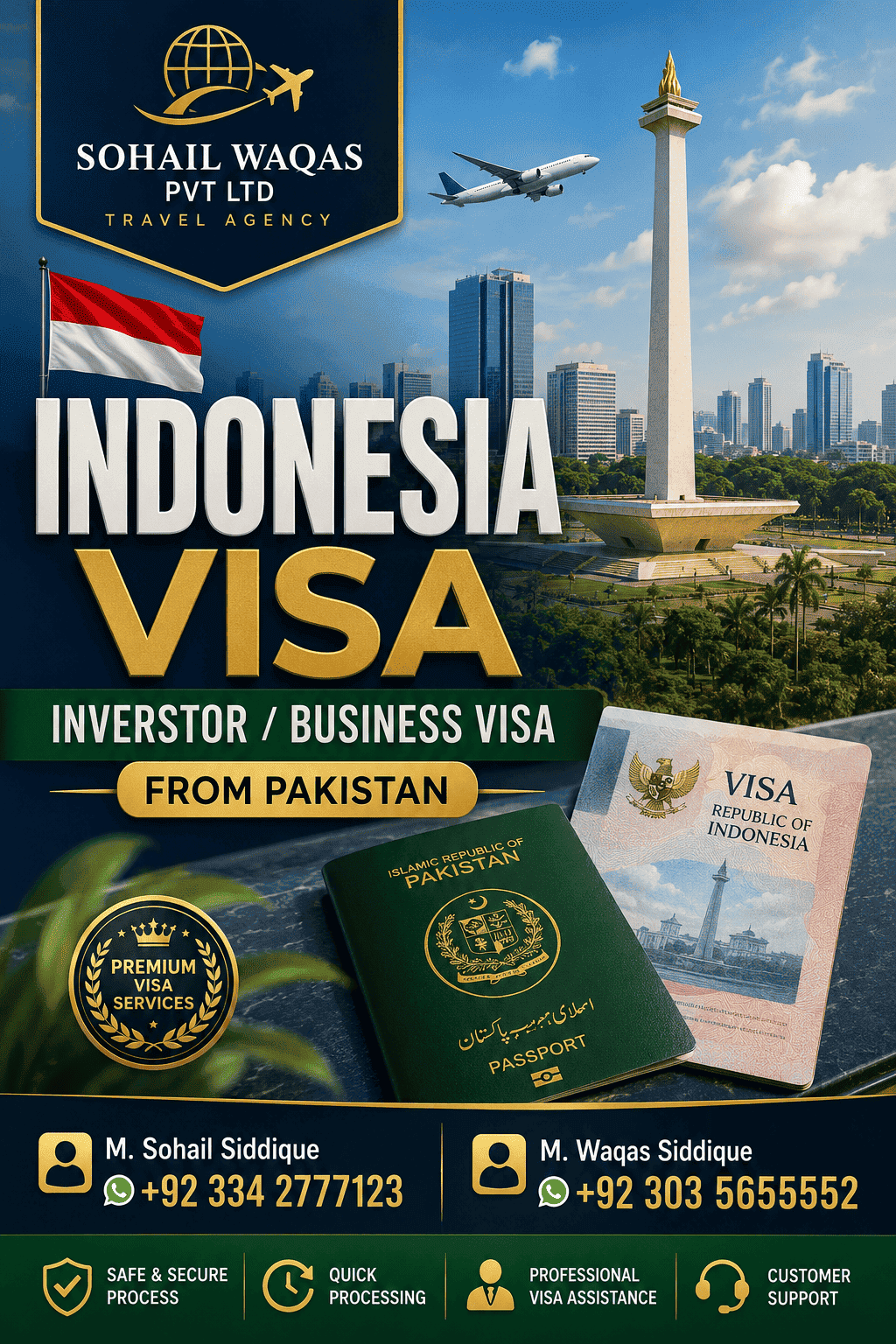
Contact Details
M. Waqas Siddique: +92 303 5655552
M. Sohail Siddique: +92 334 2777123