
Indonesia Investment Visa: A Complete Guide for Foreign Investors
Investing in another country is a major decision. You’re not only thinking about the business itself, but also immigration status, company structure, documentation, compliance, and your long-term plans.
Indonesia has attracted attention from international entrepreneurs because of its large market, diverse economy, tourism industry, manufacturing base, and growing business opportunities. For investors who want to establish a genuine business presence in the country, understanding the immigration side of the process is essential.
That’s where the Indonesia investment visa comes into the picture.
An investment-focused immigration route is different from a standard tourist or short-visit arrangement. Your purpose of travel, investment structure, business activity, and supporting documents all need to fit the requirements of the relevant Indonesian immigration category.
This guide takes you through the process from start to finish. You’ll learn what an investment visa is, who may consider it, what documents can be involved, how the application generally works, the benefits and limitations, common mistakes, and practical ways to prepare.
The exact rules and requirements can change, so your application should always be assessed according to the current Indonesian regulations and your individual circumstances.

What Is an Indonesia Investment Visa?
An Indonesia investment visa is an immigration pathway intended for eligible foreign nationals who want to make a qualifying investment or participate in an eligible business activity in Indonesia.
The exact category available to you depends on factors such as your proposed investment, business structure, role in the business, intended stay, and current immigration rules.
It’s important to understand that an investment visa isn’t simply a document that allows someone to enter Indonesia.
It is connected to a genuine investment or business purpose.
For example, if you’re traveling to Indonesia for a holiday, a tourist or visitor route may be appropriate. If you’re establishing a qualifying investment and need immigration status connected to that activity, an investor-focused route may be more suitable.
Getting this distinction right at the beginning can prevent confusion later.
Why Consider Investing in Indonesia?
Indonesia offers a combination that’s attractive to many international entrepreneurs: a large population, growing cities, established industries, tourism activity, and a broad consumer market.
Different investors will have different reasons for considering the country.
Some may want to expand an existing company. Others may be exploring a new business idea or looking for opportunities in Southeast Asia.
Potential sectors of interest can include:
-
Tourism and hospitality
-
Manufacturing
-
Trading and distribution
-
Technology and digital services
-
Food and beverage
-
Logistics and related services
-
Import and export
-
Professional services
-
Selected property-related activities
-
Other eligible commercial ventures
Of course, an attractive market doesn’t automatically make every investment suitable.
You still need to research demand, competition, regulations, local partners, company requirements, and the practical realities of running a business.
The immigration route should support that business plan rather than replace it.
Who May Be Eligible for an Investment Visa?
An investment-focused immigration pathway may be relevant to foreign nationals who satisfy the requirements for a qualifying investment or business activity.
Potential applicants can include:
-
Entrepreneurs
-
International investors
-
Company founders
-
Business owners
-
Directors or business representatives
-
Investors expanding an existing company
-
Individuals establishing an eligible business presence in Indonesia
Eligibility isn’t determined by the label “investor” alone.
The authorities may consider the nature of the investment, the business structure, supporting documents, and other immigration requirements.
This is why it’s useful to review your circumstances before making major commitments.
Key Factors That Can Affect Eligibility
Several factors can influence whether an investment immigration route is suitable for you.
Investment Structure
The way your investment is organized can matter.
You may need to understand how the investment is connected to the relevant Indonesian business or corporate structure.
Business Activity
Not every business activity is treated the same way.
Certain industries may have specific regulations, ownership requirements, licensing rules, or restrictions.
Your Role
Are you an investor, director, shareholder, founder, or another type of business participant?
Your role can affect the immigration and corporate requirements you need to consider.
Supporting Documentation
Your application needs evidence that supports the information you’ve provided.
A vague investment plan combined with weak documentation can make an application harder to assess.
Current Immigration Rules
This is a big one.
Requirements can change. A rule that applied previously may not apply in exactly the same way today.
Always check the current requirements before submitting.
Investment Visa vs Tourist Visa
Many applicants confuse these two routes.
They shouldn’t.
| Feature | Tourist or Visitor Route | Investment-Focused Route |
|---|---|---|
| Primary purpose | Tourism or permitted short-term activities | Qualifying investment or business activity |
| Applicant profile | Visitor | Eligible investor |
| Business purpose | Subject to visitor conditions | Connected to qualifying investment |
| Documents | Mainly travel-related | May include business and investment documents |
| Long-term planning | Generally limited | More suitable for eligible investors |
| Compliance | Visitor requirements | Investment and immigration requirements |
If your actual purpose is connected to investment or business activity, don’t choose a tourist category simply because it seems familiar.
Your immigration status should match what you’re legally permitted to do.
Benefits of an Investment-Focused Immigration Route
For eligible investors, there can be several practical advantages.
1. A Clearer Business Purpose
An appropriate immigration category can align your stay with your legitimate investment plans.
2. Long-Term Business Planning
If you’re serious about building a presence in Indonesia, an investor-focused route can be considered as part of a broader business strategy.
3. Market Access Opportunities
Indonesia’s large consumer market can offer opportunities for businesses with products and services that fit local demand.
4. Better Preparation
The process encourages investors to organize their business information and supporting documents.
5. Professional Guidance
If you work with an experienced consultant, you can have help navigating administrative steps and document requirements.
These benefits don’t mean that approval is automatic. Your eligibility and compliance still matter.
What Documents May Be Required?
The exact document checklist depends on the immigration category and your circumstances.
However, you may need documents such as:
-
Valid passport
-
Personal identification
-
Passport photographs where applicable
-
Application information
-
Business registration documents
-
Company ownership records
-
Investment documentation
-
Corporate information
-
Supporting financial or business evidence where required
-
Other documents requested by Indonesian authorities
Don’t assume that a document checklist from another applicant automatically applies to you.
Different investors can have different requirements.
Why Document Accuracy Matters
One of the most overlooked parts of immigration applications is consistency.
Imagine your passport says “Muhammad Ahmed,” while one company document says “Mohammad Ahmed.” To you, the difference may look harmless.
To an immigration officer, however, it may need clarification.
Before submission, compare:
-
Full name
-
Date of birth
-
Passport number
-
Company name
-
Ownership information
-
Business activity
-
Dates
-
Contact details
Clear and consistent information makes your application easier to understand.
Step-by-Step Indonesia Investment Visa Process
The exact process can vary, but the following steps provide a useful framework.
Step 1: Define Your Investment Plan
Start with the basics.
What are you investing in?
What business activity are you planning?
What will your role be?
Why do you want to establish a presence in Indonesia?
If you can’t answer these questions clearly, it’s probably too early to start the immigration application.
Step 2: Assess Your Eligibility
Once your plan is clear, review the current requirements for the relevant investor immigration category.
This can include your personal information, proposed investment, business structure, corporate role, and supporting evidence.
Step 3: Identify the Appropriate Immigration Category
Don’t skip this stage.
Indonesia has different immigration routes for different purposes.
The correct category depends on your circumstances and the rules applicable at the time of application.
Step 4: Prepare Your Documents
Collect your personal and business documents.
A simple folder structure can help:
Personal Documents
-
Passport
-
Identification
-
Photographs
-
Personal information
Business Documents
-
Company records
-
Ownership documents
-
Investment information
-
Business details
Application Documents
-
Forms
-
Supporting statements
-
Additional evidence
Step 5: Review Everything
Before submission, check every document.
Don’t only look for missing files.
Look for inconsistencies.
Make sure names, numbers, dates, and company information match.
Step 6: Submit the Application
The application should be submitted through the appropriate procedure for your selected immigration category.
Professional guidance can help you understand what needs to be prepared, but the final decision remains with the relevant Indonesian authorities.
Step 7: Handle Additional Requests
Authorities may sometimes request further information or clarification.
If that happens, respond carefully and provide the requested documentation.
Keep records of everything submitted.
Step 8: Maintain Compliance
After approval, your responsibilities continue.
You need to follow the conditions attached to your immigration status and comply with applicable Indonesian laws.
How an Investment Visa Consultant Can Help
Immigration paperwork can be frustrating, particularly when you’re also managing a business.
An experienced consultant can help organize the process.
Potential support can include:
-
Initial eligibility assessment
-
Immigration category guidance
-
Document checklist preparation
-
Application assistance
-
Document review
-
Identification of inconsistencies
-
General procedural guidance
-
Follow-up support
-
Explanation of immigration conditions
The consultant’s role isn’t to guarantee a result.
It’s to help you prepare correctly.
Think of it like having an experienced guide when you’re entering unfamiliar territory. You still make the investment decisions, but you have someone helping you understand the route.
How to Choose the Right Immigration Consultant
Not every consultant provides the same level of service.
Here are some practical things to look for.
Relevant Experience
Ask whether they understand investor and business immigration rather than only tourist applications.
Clear Process
A professional should be able to explain what happens after your first consultation.
Document Review
Don’t underestimate this service.
A careful review can catch missing information and inconsistencies before submission.
Honest Expectations
Be cautious of anyone who guarantees approval.
No private consultant controls an immigration authority’s final decision.
Good Communication
You should receive clear answers to your questions.
If a consultant uses complicated language without explaining what it means, ask for clarification.
Common Mistakes Investors Make
Choosing the Wrong Visa
This happens when applicants start with a visa name instead of starting with their actual purpose.
Using Outdated Information
Immigration rules can change.
Information from an old article or an applicant who applied several years ago may no longer be accurate.
Submitting Incomplete Documents
Missing pages, unclear scans, and incomplete forms can cause unnecessary problems.
Providing Inconsistent Information
Every document should support the same basic facts.
Ignoring Business Regulations
Immigration status doesn’t automatically give you unlimited rights to conduct every type of business activity.
You must consider Indonesian business and sector-specific regulations as well.
Relying on Guaranteed Approval
No honest professional can guarantee an immigration decision.
Waiting Until the Last Minute
Give yourself enough time to identify and fix documentation problems.
Practical Tips Before Applying
Create a Document Checklist
Don’t rely on memory.
Write down every required document and mark each one when it’s ready.
Keep Clear Digital Copies
Store readable copies of all documents in a secure location.
Check Your Passport
Make sure your passport details are accurate and that it meets the applicable validity requirements.
Prepare a Simple Business Explanation
You should be able to describe your investment plan without using complicated language.
Explain:
-
What your business does
-
What you plan to invest in
-
What your role will be
-
Why Indonesia is relevant
-
What your business intends to achieve
Don’t Copy Another Applicant
Your application should reflect your real circumstances.
A document or structure that worked for someone else may not work for you.
What Most Investors Miss
Here’s what most investors miss: the visa application should be part of a bigger plan.
Suppose you want to establish a company in Indonesia. You shouldn’t only ask, “How do I get the visa?”
You should also ask:
-
What business structure is appropriate?
-
What activities are permitted?
-
What corporate requirements apply?
-
What immigration conditions will I have?
-
What compliance responsibilities continue after approval?
The immigration route and business structure should make sense together.
When Should You Start the Process?
Start before making major commitments.
If you’re still researching Indonesia, this is a good time to understand the general immigration framework.
If you’ve already chosen an investment opportunity, you can begin organizing the relevant documents.
If you’ve already started an application, professional review can help identify potential problems.
Waiting until the last minute gives you fewer options.
Early preparation gives you time to ask questions, correct errors, and collect missing information.
Can an Investment Visa Holder Run a Business?
The answer depends on the specific immigration status, business structure, activity, and applicable Indonesian laws.
An investment-related immigration status doesn’t necessarily mean you can perform every type of business activity without additional requirements.
You may also need to consider:
-
Company registration
-
Business licensing
-
Sector-specific rules
-
Ownership requirements
-
Corporate compliance
-
Tax responsibilities
-
Employment rules
-
Immigration conditions
For complex corporate or legal questions, appropriate Indonesian legal or business professionals may also be needed.
Pros and Cons of Professional Assistance
| Potential Advantages | Things to Consider |
|---|---|
| Structured guidance | Choose a reputable consultant |
| Document organization | You must provide genuine information |
| Application support | Approval remains with authorities |
| Help identifying errors | Rules can change |
| Easier understanding of procedures | Individual cases can differ |
| Practical follow-up guidance | Consultant services don’t replace legal compliance |
For someone unfamiliar with Indonesian immigration procedures, professional assistance can make the administrative side much easier to manage.
A Pre-Application Checklist
Before submitting your application, review the following:
-
Confirm the appropriate immigration category.
-
Check your passport and personal details.
-
Organize your investment information.
-
Prepare relevant company documents.
-
Check all names and dates.
-
Review application forms carefully.
-
Make sure supporting documents are clear.
-
Confirm any translation or certification requirements.
-
Keep copies of everything submitted.
-
Understand your immigration conditions.
-
Check the current requirements before submission.
This simple review can catch problems that are surprisingly easy to overlook.
Why Preparation Matters
Some investors focus heavily on speed.
They want the application submitted immediately.
But faster isn’t always better.
Imagine preparing an important business contract. You could sign it quickly, but if the company name is wrong or an important clause is missing, speed doesn’t help.
Immigration applications work in a similar way.
A careful application with consistent information is usually a better starting point than a rushed application that needs corrections later.
Planning for the Future
If your goal is to build a lasting business presence in Indonesia, don’t stop thinking about immigration after the initial approval.
Consider the future.
Your circumstances may change. Your company may expand. Your business activity may evolve. You may need to understand renewal or continuation requirements, reporting responsibilities, or changes to immigration rules.
Keeping your business and immigration information organized from the beginning can make future administration easier.
Why Choose Professional Guidance?
For an international investor, the hardest part isn’t always completing the form.
It’s knowing what the form means, what documents support it, and whether the information you’re providing makes sense as a complete application.
That’s where professional guidance can help.
An experienced consultant can provide a structured process so you know what needs to happen next.
You still remain responsible for providing accurate information, but you don’t have to navigate every administrative detail alone.
Start Your Indonesia Investment Visa Journey
Indonesia can be an interesting destination for entrepreneurs who want to explore international investment opportunities.
But successful immigration planning requires more than choosing a visa name.
You need a legitimate investment purpose, the appropriate immigration category, accurate documentation, a clear understanding of business requirements, and ongoing compliance.
If you’re considering an Indonesia investment visa, now is the time to start preparing.
Our team can help you understand the process, organize your documents, and guide you through the practical steps based on your circumstances.
Don’t leave an important investment and immigration decision to guesswork.
Contact our team today, discuss your plans, and take the first step toward a properly prepared Indonesia investment visa application.
FAQ Section
1. What is an Indonesia investment visa?
An Indonesia investment visa refers to an investor-focused immigration pathway for eligible foreign nationals who meet the applicable requirements for qualifying investment or business activity in Indonesia.
2. Who can apply for an Indonesia investment visa?
Eligible foreign nationals who satisfy the requirements of the relevant investor immigration category may apply. Eligibility can depend on the investment structure, business activity, documentation, and current Indonesian immigration rules.
3. What documents are needed for an Indonesia investment visa?
Requirements vary by applicant and category. Documents may include a valid passport, identification, business records, investment-related documentation, application information, and other supporting evidence.
4. How long does the Indonesia investment visa process take?
Processing times can vary depending on the immigration category, application completeness, document verification, and the procedures of the relevant authorities. Applicants should confirm current processing expectations for their specific case.
5. Can an immigration consultant guarantee investment visa approval?
No. A consultant can help prepare and organize an application, but the final decision is made by the relevant Indonesian authorities.
6. When should I apply for an Indonesia investment visa?
It’s generally best to begin planning before making major investment commitments. Early preparation gives you time to understand the requirements, organize documents, and address potential issues.
Contact Details
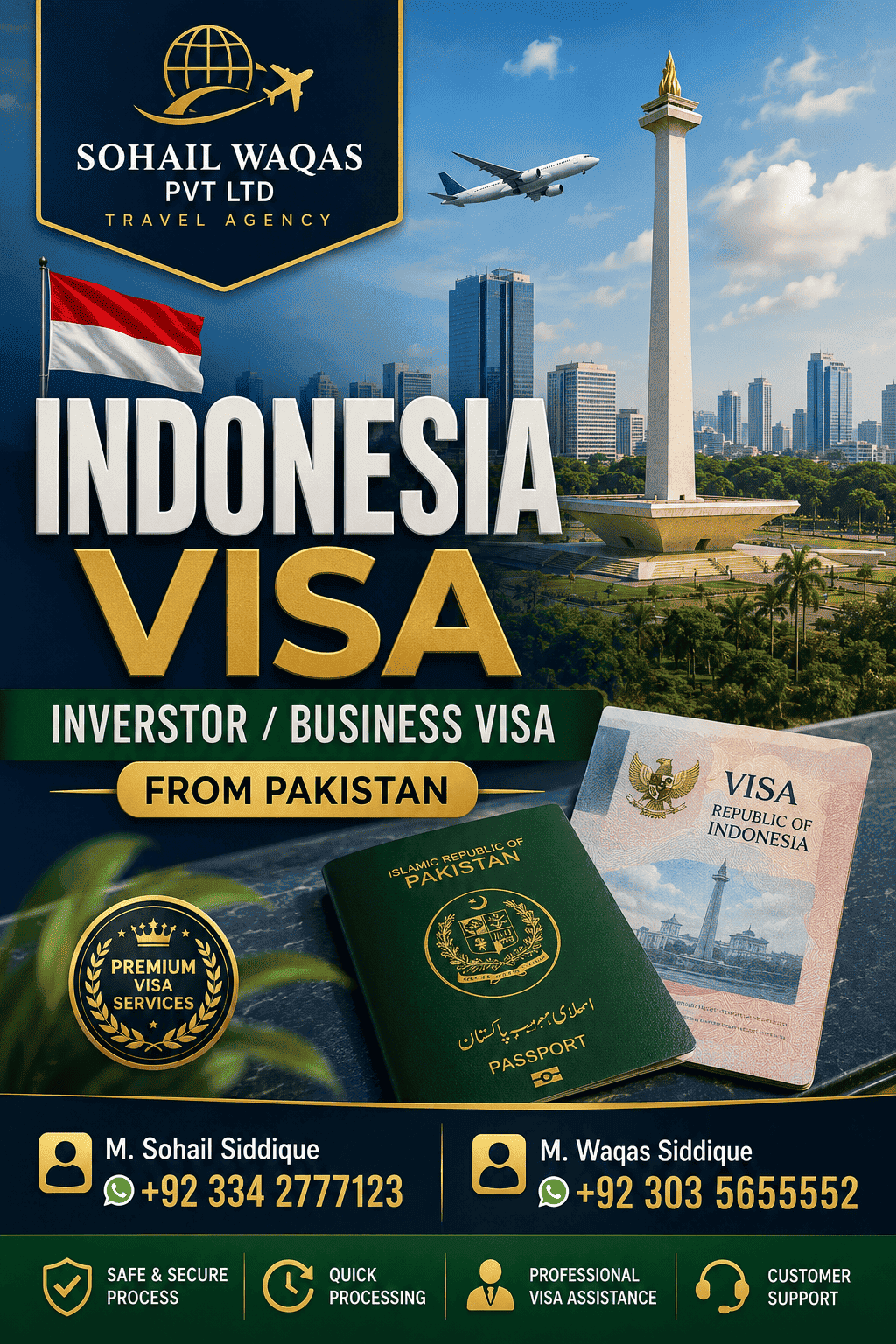
M. Waqas Siddique: +92 303 5655552
M. Sohail Siddique: +92 334 2777123
Contact our team for professional guidance regarding your Indonesia investment visa application and discuss your investment plans with us.